
Depends. Everyone has a one leg that is longer than another, but often the difference is so small its not necessarily detectable. Obviously, if a large amount, there is probably going to be problems due to the changes in alignment of the spine and other parts of the body. Obviously if the difference is a miniscule amount, its probably not going to be a problem. Where the debate and discussion is just where is the cut-off point is as to if the difference is clinically significant or not. Some people think a few millimeters is important; yet others think that its not important until it at least a few inches. It is also going to depend on activity levels. A few millimeters might be important if you run marathons. A few inches is not going to be important is you lead a sedentary lifestyle. There is very little research to guide this process. More information is certainly needed to base decisions on.
This is somewhat of a controversial topic as it new, expensive and a lot of unsubstantiated claims get made for it. Fungal infections of the toenails (or onychomycosis) is a common problem. It causes the nails to become deformed and grow with a yellowish discoloration. The biggest issue in this problem is that treatment can takes months as you need to wait until the fungal elements grow out with the nail as it grows. During that time, especially in the damp and moist environment of the shoe, the nail can easily get infected again as the fungus just love that dark and moist environment in the shoe. So, whichever treatment is used, no matter how good it is can easily fail due to the reinfection. The use of the laser has become popular in recent years with lots of anecdotes but no hard science to support it. The FDA have approved it as safe, but have not tested how effective it is. There are plenty of other treatments that have been shown to work. More research is needed to know how the laser treatment stacks up to the other treatments.
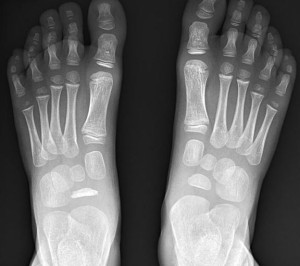
Kohlers Disease is a problem with the navicular bone in the arch of the foot in young kids with a peak incidence around are 5 years. It usually presents as a ache on the top of the arch of the foot and often also causes the child to limp. Kohlers Disease is due to a temporary block in the vascular supply to the bone to cause an osteochondrosis or softening of the bone. The exact cause of this is not known, but is often thought to be biomechanical as the bone is an important part of the arch of the foot. On x-ray the bone appears more sclerotic and thinner than the other side:

The treatment of this condition is the use of a cast or splint with a period of non-weight bearing to allow the bone to heal.
The Kinetic wedge is an extension to a foot orthotic that is patented by Howard Dananberg. The aim of this extension is to facilitate motion at the first metatarsophalangeal joint to treat functional hallux limitus. The Kinetic wedge hold the hallux in a dorsiflexed position and also elevates the lateral metatarsals. The effect of this is to plantarflex the first metatarsal head.
